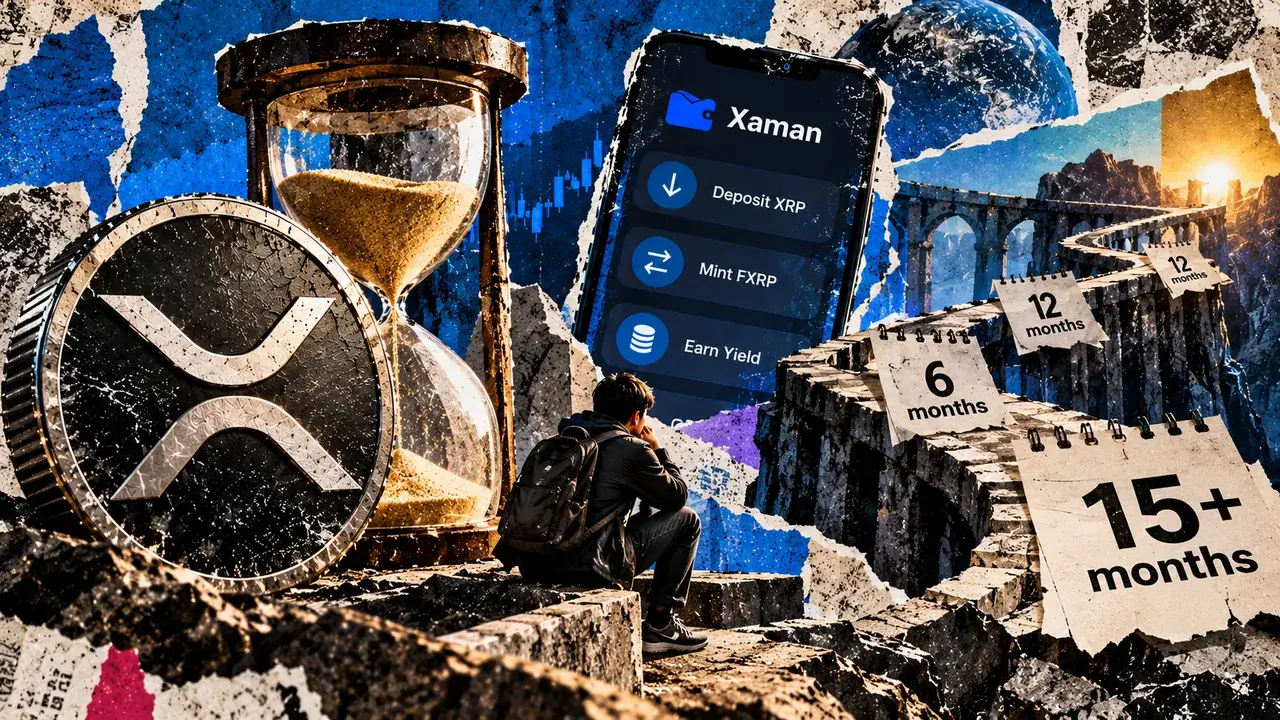
The XRP ecosystem's expansion into DeFi yield products reflects a broader pattern in crypto: networks optimize for throughput and security first, then layer financial primitives on top. Xaman wallet's earnXRP integration represents XRP Ledger's most accessible path to on-chain yield, routing native XRP through Flare's secured cross-chain mechanism into Clearstar's earnXRP vault via Upshift infrastructure. The architecture is technically sophisticated — but the fee structure creates economics that disadvantage precisely the retail users most likely to use a mobile-first wallet.
The full cost stack for a first-time user requires careful accounting. Entering a 100 XRP position triggers: Xaman's 0.5% service charge (0.5 XRP), a 0.11% FXRP minting fee calculated on the post-deduction balance (~0.109 XRP), and a one-time 2 XRP Smart Account setup cost. Before the first unit of yield accrues, roughly 2.609 XRP has been consumed — approximately 2.61% of a 100 XRP initial deposit. Exit triggers an additional 0.2% redemption fee on the ending balance. The round-trip entry-plus-exit cost for a naive 100 XRP position approaches 2.8% before accounting for network transaction fees.
Against Xaman's illustrative 2.25% net APY, recovering these entry costs requires approximately 15.4 months of uninterrupted deployment. The mathematics of scale work against small depositors: the fixed 2 XRP Smart Account fee represents 2% of a 100 XRP deposit but only 0.02% of a 10,000 XRP position, compressing the break-even period to 4.5 months for larger positions. This fee structure is typical of cross-chain DeFi infrastructure — protocol setup costs are fixed regardless of deposit size — but it creates a meaningful access barrier for the retail segment Xaman primarily serves.
The most significant risk factor for prospective depositors is the gap between Xaman's illustrative yield assumptions and observed vault performance. Xaman's break-even calculations use a 2.25% effective net APY derived from a 3.5% gross yield assumption. The vault's actual trailing 30-day Total APY as of October 21 was 1.18% — and this figure incorporates vested rFLR rewards that carry separate vesting schedules, meaning the immediately spendable XRP yield may be lower still. At a constant 1.18% effective net rate, the break-even horizon for 100 XRP extends to approximately 29.1 months — over 2.4 years of uninterrupted deployment to recover entry costs alone.
The cross-chain dependency introduces risks beyond yield rate uncertainty. The documented withdrawal timeline shows tension between Upshift's guide (queued withdrawals within 72 hours, optional instant exit with liquidity-dependent fees) and a two-day standard period listed on the vault page. During XRP price volatility — the asset declined approximately 9.1% in the 30 days preceding October 21 — the inability to exit instantly can transform a positive XRP balance into a negative dollar outcome even when the round-trip yield math is technically positive.
From a DeFi protocol design perspective, the earnXRP architecture highlights a recurring tension: cross-chain yield products require multiple protocol layers (XRPL, Flare, Upshift, Clearstar), each adding fees, risks, and complexity. The aggregate disclosed costs — Xaman service fee, FXRP minting, Smart Account setup, redemption fee, management fee (0.75%), performance fee (10%) — create a fee stack that requires sustained, above-average yield to justify for small depositors. DeFi protocols targeting retail adoption would benefit from transparent all-in cost calculators that incorporate all protocol layers, rather than single-layer fee disclosures that understate the true cost of participation.
Keywords: XRP, Flare, DeFi yield, cross-chain, XRPL
Source: CryptoSlate