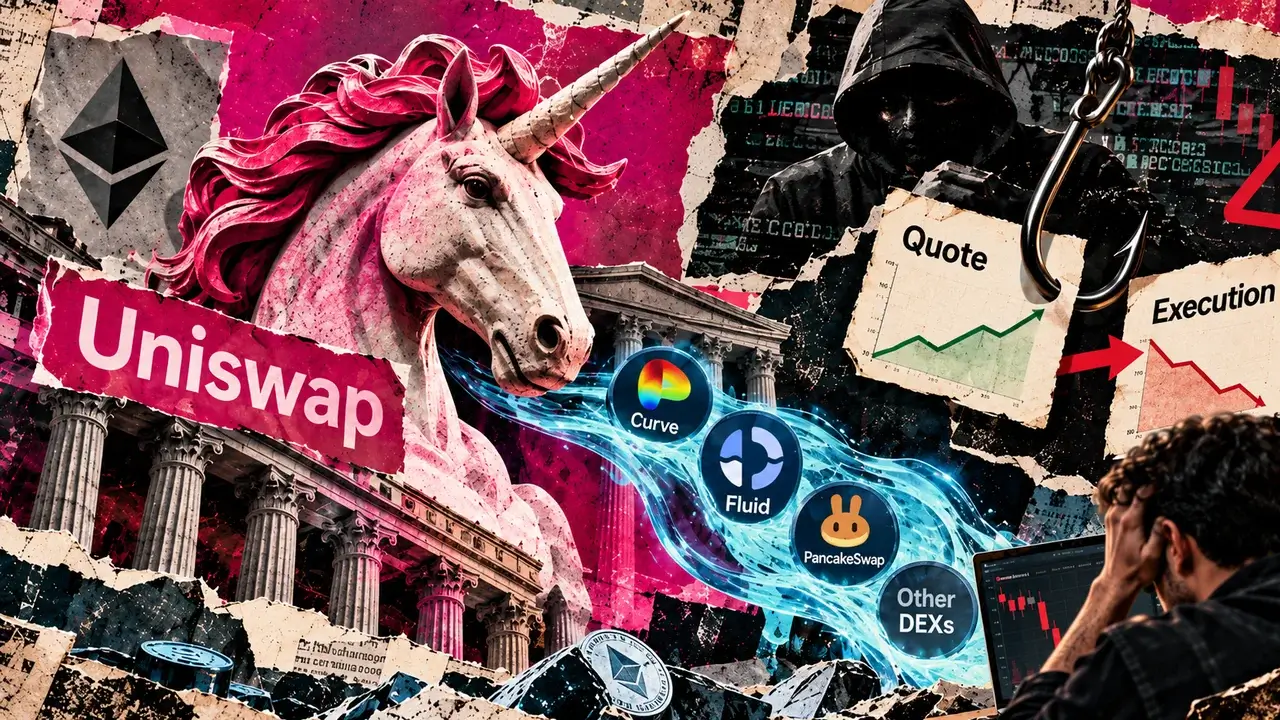
Uniswap Labs' October 22 launch of aggregator hooks marks a significant architectural shift for the protocol: for the first time, Uniswap's web app and API can natively route swaps through external liquidity venues — Curve, Fluid, PancakeSwap, and four others — without requiring users to leave the Uniswap interface. The seven integrations collectively cover more than 90% of DEX activity on the three supported chains, representing a meaningful step toward consolidated liquidity access.
However, the launch arrives against a backdrop of unresolved security disputes that directly implicate the hook architecture central to this expansion. In September 2026, trading aggregator 0x published research examining 84,163 hooks across six chains, classifying 54.2% as malicious and 26.4% as "likely malicious." The firm documented hooks capable of quote manipulation — returning favorable prices during simulation while executing different terms at settlement — with documented losses reaching 50% shortfalls in extreme cases. A single Base hook accumulated 6,516 fills and $143,037 in fees before detection.
The core technical dispute centers on detection reliability. Uniswap founder Hayden Adams characterized the issue as a "skill issue" in router configuration, pointing to Uniswap's hook allowlist as the primary mitigation. 0x engineer Duncan Townsend directly contested this defense, alleging that at least one malicious hook had been present on Uniswap's own allowlist — a claim that, if accurate, undermines the allowlist as a security boundary rather than a routing preference.
The OpenZeppelin audit of specific router and periphery changes, completed October 8, introduces optional per-hop slippage checks as a supplementary protection layer. The keyword is "optional": traders can bypass this protection by passing an empty maxHopSlippage array. For sophisticated DeFi users who understand the parameter, the protection is available; for casual users relying on interface defaults, the protection's actual deployment depends on Uniswap's frontend implementation choices — choices that remain opaque from the published audit scope.
The Enso investigation of a Curve USDC/USDT pool adds a concerning data point given Curve's inclusion as a launch partner: 129,070 swaps delivered less than quoted, with ~$225,000 in gross overstatement and ~$34,593 in estimated attacker extraction. Whether the specific pool flagged in that research is accessible through the new Uniswap adapters remains unconfirmed — a disclosure gap that Uniswap should address directly.
From a DeFi market structure perspective, the UNI burn mechanism tied to external liquidity fees creates an interesting incentive alignment: Uniswap has a token-economic interest in maximizing routed volume through the new adapters, which could create tension with rigorous ongoing hook vetting. The protocol's path to resolving the 0x dispute runs through execution-quality data publication — comparing quoted prices versus settled prices across the new integrations at scale. Until that data exists, the expansion of seven new routing surfaces represents both a genuine liquidity improvement and a proportional expansion of the attack surface documented in 0x's research.
Keywords: Uniswap, DeFi hooks, DEX security, liquidity aggregation, Web3 trading
Source: CryptoSlate