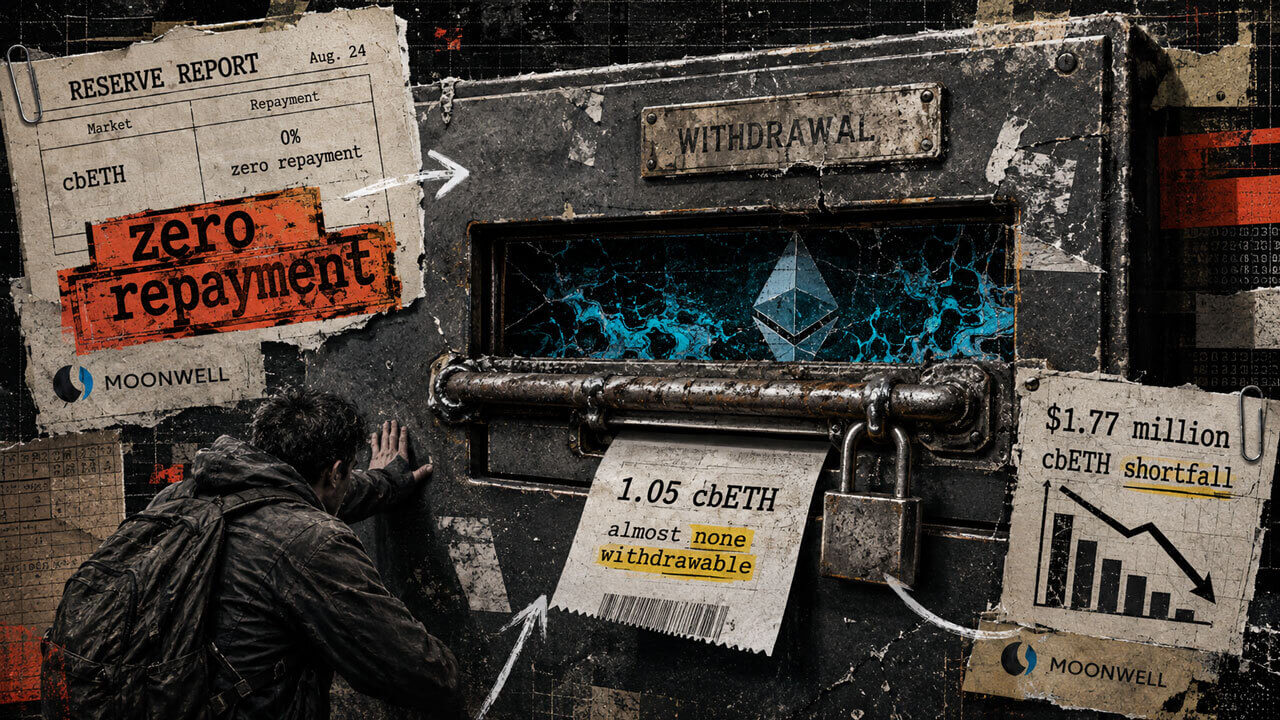
Decentralized lending protocol Moonwell is sitting on a $1.77 million cbETH shortfall — and its latest reserve allocation plan dedicates exactly zero dollars to fixing it. The gap, now months old, stems from a February oracle misconfiguration that briefly priced cbETH at roughly $1.12 instead of ~$2,200, triggering mass liquidations and leaving the protocol with unrecoverable bad debt.
For DeFi researchers and protocol observers, Moonwell's situation is a live case study in what happens when oracle failures cascade into structural insolvency — and how recovery governance can stall even when the numbers are clearly on the table.
On February 15, a misconfiguration in Moonwell's cbETH price feed on Base caused the protocol to drastically underprice the asset. With cbETH showing near-zero value, liquidators moved fast: 1,096.317 cbETH was seized across a window spanning February 14–18. When the dust settled, the protocol carried approximately $1.8 million in initial bad debt, and roughly 181 borrowers had been liquidated at distorted prices.
A recovery proposal drafted in February estimated net losses of about $2.7 million across affected participants and outlined a two-phase plan: immediate treasury funding followed by ongoing protocol-revenue repayments. That proposal was never fully executed.
Published by Moonwell's risk service provider Anthias Labs on August 24, the latest reserve allocation follows a specific ruleset:
Applied to cbETH, the plan lists $1,768,665.13 in gross bad debt, a $1,768,664.86 net shortfall, and just $7,360.83 in reserves. The allocation column reads $0. The document does not explain whether the $1,000 cutoff, a cash availability constraint, or another factor produced that outcome.
The cbETH row makes the math visible but not the reasoning — $7,360 in reserves against a $1.77M hole produces $0, yet the plan offers no explicit logic for why partial repayment or alternative sourcing was ruled out.
This isn't merely a paper deficit. Moonwell's Base markets API, checked at 11:28 UTC on August 25, showed $1.93 million supplied against $1.94 million borrowed in the cbETH market — with negative $8,223.63 in available liquidity and utilization sitting at 100.43%. When utilization exceeds 100%, the protocol has lent out more than it holds, making withdrawals structurally impossible until new liquidity enters the pool.
At least two suppliers publicly reported being unable to withdraw. One described a 1.05 cbETH position — with no borrow history and no prior liquidation — showing approximately 0.0000000001 cbETH available to withdraw. Moonwell's own documentation acknowledges that withdrawals depend on available liquidity, but stops short of offering a timeline or resolution path.
Neither Moonwell nor Anthias Labs had responded in the public forum thread by 11:30 UTC on August 25. That silence matters. In DeFi protocols, governance response time and transparency are often the leading indicators of whether a bad-debt situation resolves cleanly or metastasizes into broader trust erosion.
For Ethereum L2 ecosystem observers — Base being an OP Stack chain — this episode adds to a growing body of evidence that oracle redundancy and circuit breakers are not optional features for lending protocols operating with real economic weight. Protocols like Aave v3 have implemented price deviation guards and borrow caps per asset precisely to contain scenarios like this one.
The Moonwell cbETH situation highlights three structural risks that any DeFi lending researcher should track:
Whether Moonwell's governance community will push for a revised plan that draws on broader treasury resources — or whether affected suppliers will pursue other remedies — remains an open question. For now, 100%+ utilization and a $0 recovery allocation tell a story that the protocol has yet to fully answer.
Keywords: Moonwell, DeFi lending, cbETH, oracle error, Base network
Source: CryptoSlate