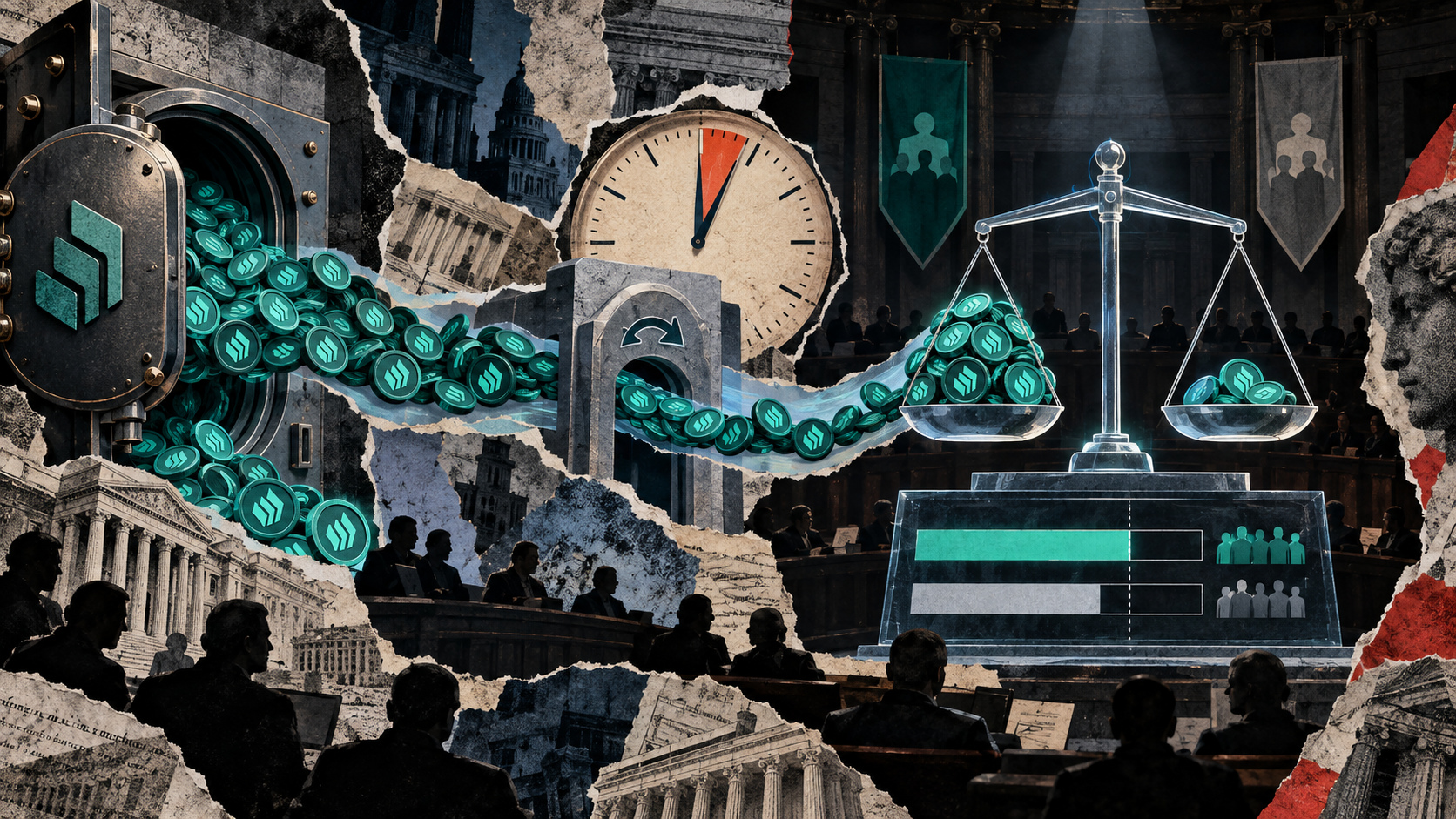
Compound DAO passed a contentious treasury restructuring proposal in May only because protocol reserves were used to purchase $52 million in COMP tokens 58 minutes before the voting snapshot — a sequence that critics say converted DAO assets into a governance weapon and breached the reserve mandate.
On-chain analysis firm Bitquery reconstructed the timeline: 344,780 COMP arrived in a DAO reserve wallet at 09:46 UTC on May 5, 2026, less than an hour before the snapshot that locked voting power for Proposal 582. That wallet had delegated its votes to the Compound Foundation, which sponsored the restructuring plan. When the snapshot fired, Foundation-aligned supporters controlled 50.1% of all delegated votes — a razor-thin majority of 1,883,966 out of 3,757,805 total. Proposal 582 passed with zero votes against, an outcome that masked the underlying power arithmetic.
Bitquery's significance lies not in what happened but in what the numbers reveal about what would have happened without the reserve purchase. Strip out the 344,780 COMP and the eligible voting pool contracts to 3,413,025. Foundation supporters would have held 1,539,186 votes — 45.1% — leaving a blocking majority outside their coalition. Proposal 582 would have failed on a straight vote. That counterfactual, surfaced by forum delegate ugurmersin on September 27, is now the core of the governance dispute: whether the Foundation's use of DAO reserves to acquire tokens days before a critical snapshot constitutes legitimate governance-continuity action or a structural manipulation of the voting mechanism.
Compound Foundation responded on September 28 with a three-point rebuttal: the conversion was consistent with the mandate's governance-continuity purpose; the COMP remained DAO-owned throughout and was never transferred to the Foundation's operational wallet; and none of the assets were spent on Foundation operations. The full reserve deployment allocated $38 million to a Treasury Management Committee pool and $14 million to a Foundation operational wallet, sourced from 8.42 million DAI in old protocol reserves.
The Compound case surfaces a structural vulnerability that extends well beyond one protocol. Most DeFi governance systems assume that protocol reserves and governance token supply are distinct domains — reserves fund protocol operations, tokens express stakeholder preferences. When a foundation can move assets between those domains on a 58-minute timeline before a binding snapshot, the separation collapses. Voting power becomes a function of treasury management discretion, not long-run token holder distribution.
"Without the reserve-wallet COMP, supporters would have held 45.1% of delegated voting power — short of the majority needed to pass Proposal 582." — Bitquery on-chain reconstruction, September 2026
Compound remains one of DeFi's founding lending protocols with significant TVL. Governance credibility is a direct input to that TVL: users lending and borrowing at scale need confidence that parameter changes — collateral ratios, liquidation thresholds, reserve allocations — reflect genuine stakeholder consensus rather than foundation-directed block voting. The delegate community's reaction to the Proposal 582 reconstruction suggests that confidence is under pressure. Whether the Foundation's legal interpretation of its mandate is correct matters less than the on-chain optics: a 58-minute window between a $52 million reserve purchase and the snapshot that decided the vote is precisely the kind of sequence that erodes the credibility of decentralization claims.
The dispute is unlikely to be resolved at the forum level. Expect governance reform proposals addressing pre-snapshot transfer restrictions, mandatory delegation disclosure for reserve wallets, and independent mandate interpretation to emerge in the coming weeks — each of which will itself require a majority vote among the same delegated holders whose power distribution is now in question.
Keywords: Compound DAO, COMP governance, DeFi protocol governance, on-chain voting, protocol reserves, governance attack, Proposal 582, DeFi TVL, Bitquery, DAO mandate
Source: CryptoSlate