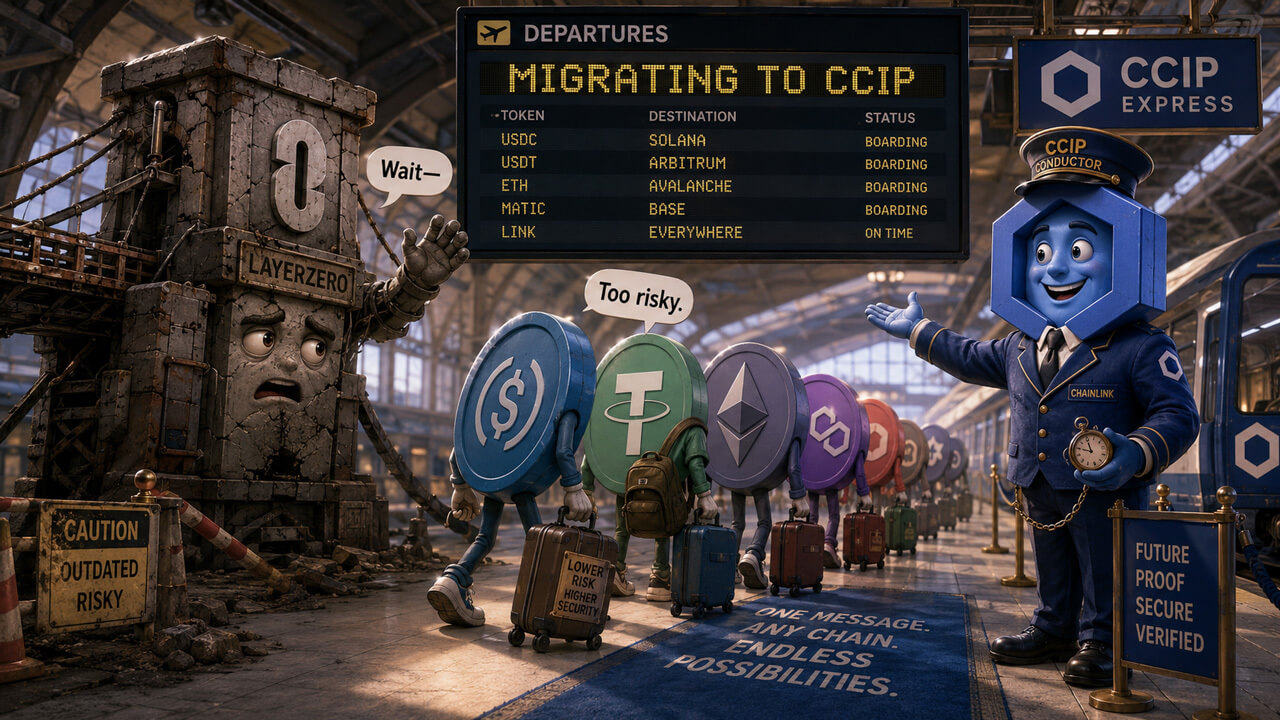
The KelpDAO exploit had an unexpected secondary effect: a significant reallocation of oracle and cross-chain infrastructure spending from LayerZero to Chainlink. Within two weeks of the exploit, five DeFi protocols announced they were migrating their cross-chain messaging infrastructure from LayerZero to Chainlink CCIP. The migration flows represent approximately $3.2B in TVL that changed its underlying messaging infrastructure provider. Chainlink did not exploit the situation — it benefited from being perceived as the more conservative choice when risk appetite collapsed.
KelpDAO used LayerZero for cross-chain restaking position synchronization. The exploit was not caused by LayerZero; the reentrancy vulnerability was in KelpDAO's own smart contracts. But the association created reputational pressure on LayerZero in a market environment where every risk was being repriced.
The more substantive concern raised in post-exploit analysis was LayerZero's trust model: its security relies on an off-chain oracle and off-chain relayer that must both be compromised for a message to be forged. Critics argued that this two-of-two model is more fragile than Chainlink's decentralized oracle network model, where a supermajority of independent nodes must be compromised to forge a price feed.
Chainlink's market position has consistently strengthened after major DeFi exploits. After the Ronin Bridge exploit in 2022, projects moved to Chainlink CCIP for cross-chain messaging. After the Wormhole exploit, similar migrations occurred. The pattern reflects a consistent dynamic: when the market is risk-tolerant, protocols choose infrastructure based on cost and performance. When risk appetite contracts, they choose based on security track record.
"Chainlink is the boring choice. In DeFi, boring choices look stupid during bull markets and look brilliant after exploits. We've seen this pattern three times now."
LayerZero published a detailed security architecture post following the migrations, clarifying that its DVN (Decentralized Verifier Network) model provides meaningful security guarantees when properly configured. The critique that LayerZero relies on a single oracle and relayer applies only to its simplest configuration; sophisticated deployments can require multiple independent DVNs.
Infrastructure migration in DeFi is expensive and complex — protocols must redeploy smart contracts, update documentation, re-verify integrations, and communicate changes to users. The fact that five protocols considered the migration worthwhile signals that the perceived security premium of Chainlink over LayerZero is currently valued above the migration cost. For Chainlink, the $3B migration represents roughly 15% growth in CCIP-secured TVL from a single two-week period. This is the business model working as intended: being the conservative choice generates disproportionate value capture during risk events.
Keywords: Community|Crime|DeFi|Featured|Technology|Web3|chainlink|KelpDAO|LayerZero
Source: CryptoSlate.com