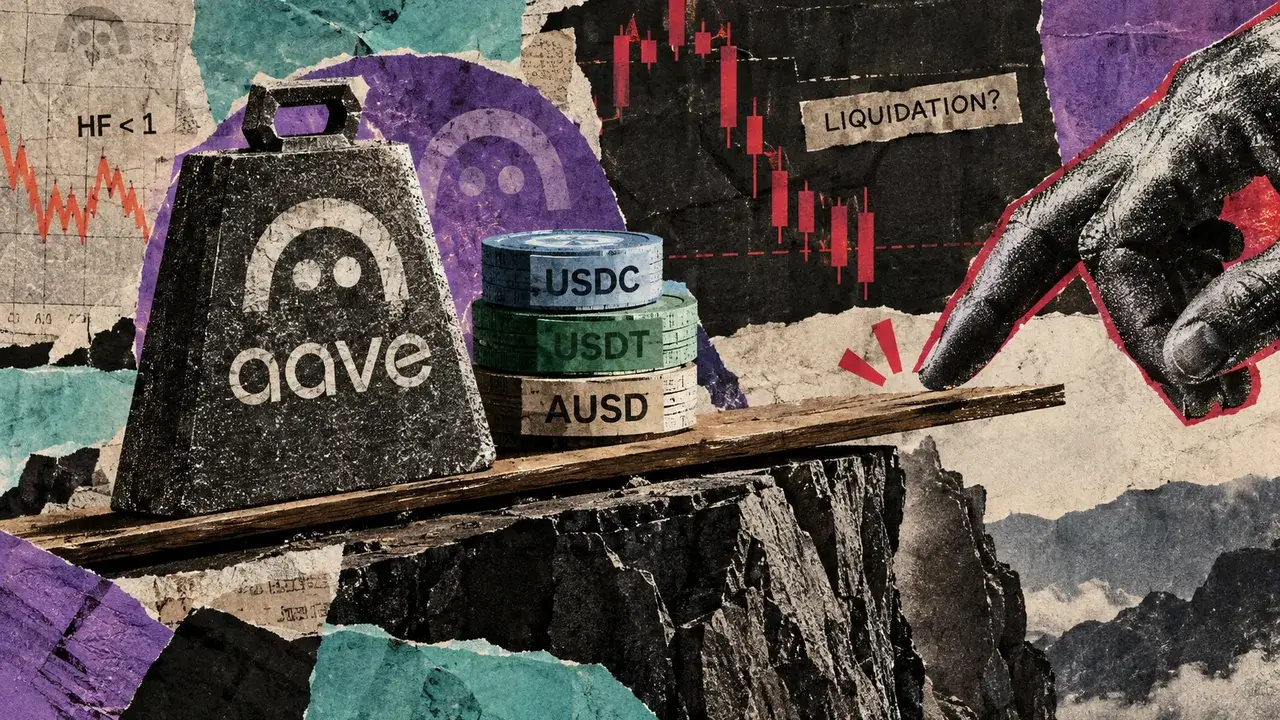
Aave lending positions backed by yield-bearing collateral are operating with dangerously narrow safety margins, according to an October 9 snapshot reviewed by LlamaRisk. Select PT-AUSD positions on Monad and syrupUSDC positions on Arc carried health factors as low as 1.01 — a razor-thin cushion above the liquidation threshold — while the structural mechanics of both collateral types create a cash-flow sequencing problem that could leave liquidators exposed for hours or days before recovering funds.
The core risk is not merely the proximity to liquidation triggers, but the time-to-cash asymmetry embedded in these assets. Unlike standard stablecoins, PT-AUSD requires marketplace presales before its December 2026 maturity, and Arc's syrupUSDC must be redeemed through a queue-based Maple Finance withdrawal system that can extend up to 30 days. When a liquidator steps in to repay a borrower's debt, they receive illiquid collateral — and must finance the gap between debt repayment and collateral exit themselves.
Monad's collateral asset is PT-AUSD-17DEC2026, a Pendle principal token representing AUSD redemption rights at the December 17, 2026 maturity date. LlamaRisk's October 9 data showed every major PT-AUSD supplier on Monad carried outstanding debt, with health factors ranging between 1.01 and 1.18 and a median of just 1.03. LlamaRisk had previously recommended increasing the 30 million PT supply cap to 60 million — a cap that was already fully utilized at review time.
The valuation methodology introduces an additional layer of complexity. Aave's implementation prices PT-AUSD using a linear discount oracle pegged to AUSD/USD, following a "predictable path toward maturity independent of AMM prices." In practice, this means the protocol's internal collateral value can diverge significantly from what liquidators could actually realize in the Pendle marketplace — especially during periods of elevated PT selling pressure when pool composition shifts away from the SY side. At the time of review, the Pendle pool was split 47% PT and 53% SY, meaning any large liquidation would compound the exit pricing pressure by drawing down the SY buffer.
The two largest syrupUSDC positions on Arc held approximately 97% of total supplied syrupUSDC, with health factors of 1.02 and 1.01. All outstanding debt in these positions was denominated in USDC. Arc itself held substantial liquidity at the time — 143.45 million USDC in the Core Hub, with 59.63 million available — but that liquidity represents debt-token inventory within Aave's own pool, not a guarantee of collateral exit capacity.
LlamaRisk's earlier September assessment of Arc had already flagged the local venue saturation problem. The October review confirmed the constraint remained unresolved, with no mechanism to guarantee timely cash conversion during a liquidation cascade.
For professional liquidators, these scenarios require explicit modeling of the financing gap. The standard liquidation workflow — supply stablecoin debt repayment, receive collateral, convert collateral to cash — works cleanly when collateral is liquid. With PT-AUSD or syrupUSDC, the conversion step introduces time and cost variables that directly compress or eliminate the liquidation incentive.
"Liquidators must compare recoverable collateral proceeds at the relevant liquidation scale against debt repaid, total exit expenditures, and any financing costs." — LlamaRisk, October 2026
If the cost of financing the collateral exit period — whether through overnight lending rates or opportunity costs — exceeds the liquidation bonus, rational liquidators may delay or avoid the position entirely. This creates the possibility of under-liquidation: positions remaining open past their trigger point because no liquidator finds the economics sufficiently attractive.
LlamaRisk's October 9 recommendations called for increasing market caps for both PT-AUSD on Monad and syrupUSDC on Arc. Larger caps expand protocol revenue potential and allow more users to access yield-bearing collateral strategies — but they also scale the aggregate liquidation problem. A larger supply cap with the same illiquid collateral mechanics means a proportionally larger financing burden for liquidators during stress events.
The broader DeFi lesson here is one of collateral quality taxonomy. Yield-bearing assets introduce a structural wedge between accounting value (what the oracle reports) and liquidation value (what the market will pay under time pressure). As Aave and other money markets expand their collateral universes to include Pendle PTs, restaking receipts, and queue-redeemable vault shares, the gap between these two values becomes a systemic variable — not a marginal footnote. Position sizing relative to pool depth, oracle methodology alignment with exit pricing, and explicit liquidation timeline modeling are becoming baseline requirements for risk-conscious DeFi protocol governance.
Keywords: Aave, DeFi, liquidation, yield-bearing collateral, PT-AUSD, syrupUSDC, Pendle, Maple Finance, on-chain risk, Monad
Source: CryptoSlate