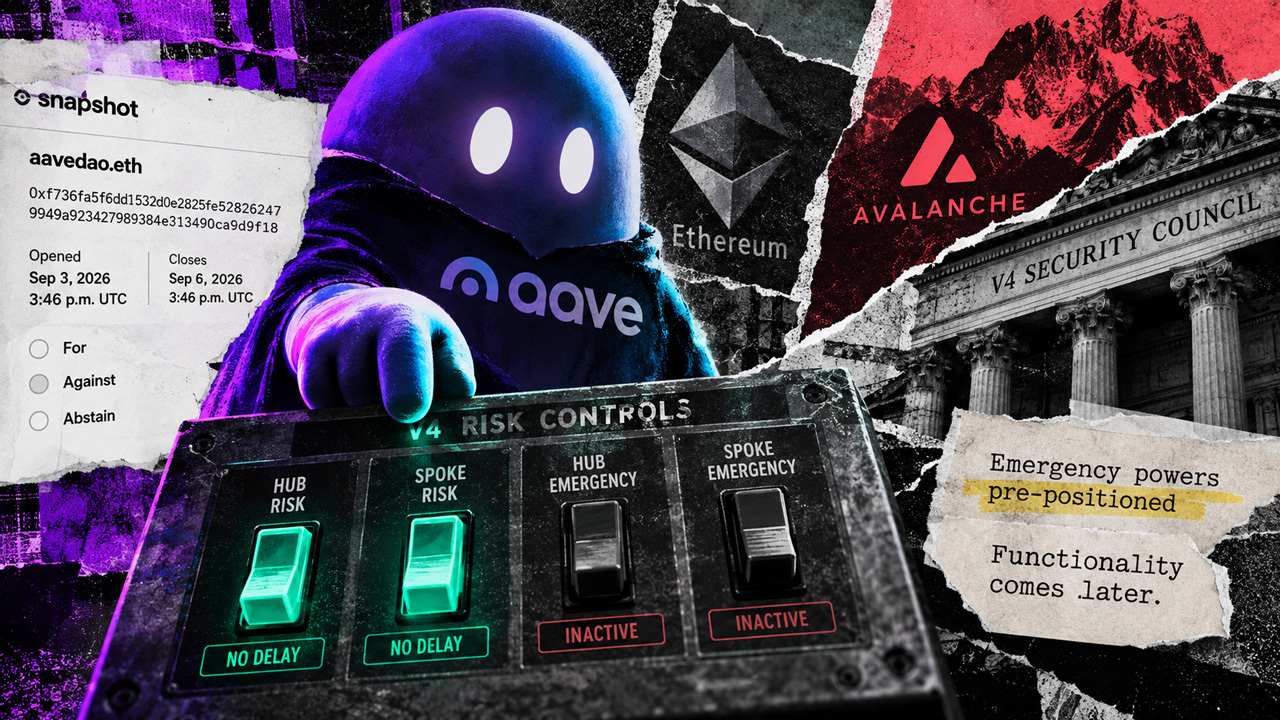
Aave DAO is voting on a proposal that would pre-position one-way emergency freeze authority inside V4 Risk Steward contracts — granting operators the power to halt markets instantly, but deliberately stripping any corresponding power to reopen them. If passed and executed, this asymmetric design becomes the new governance floor for Aave's Ethereum and Avalanche deployments, with implications that extend far beyond Aave itself into how DeFi protocols balance on-chain decentralization with real-world incident response.
The Snapshot vote opened September 3 and closes September 6, 2026. Approval alone does not activate the system — the V4 Security Council must still execute the corresponding payloads, and the emergency selectors themselves remain inert until a future Risk Steward release enables them. The proposal is best understood as infrastructure pre-positioning: the roles are granted now so that, when the next crisis hits, no secondary governance cycle is needed to hand out access.
The proposal introduces a granular role decomposition across V4's Hub and Spoke configurator model. Each V4 instance would divide its administrative surface into five discrete categories:
The deliberate exclusion of the flag-control roles from Risk Steward access is the structural linchpin. It means the steward can lock a market in response to an exploit or oracle failure, but market reopening requires a full governance vote — a design choice that privileges caution over speed on the recovery side.
Separate from emergency authority, the proposal defines tight operational boundaries for day-to-day risk tuning. Parameter updates face minimum cooldowns of 36, 48, or 72 hours depending on the variable, plus hard caps on how far any single update may shift a given setting. The parameters in scope include interest-rate curves, collateral factors, liquidation thresholds, and oracle caps — the core levers that determine protocol solvency under stress.
The cooldown-plus-cap structure mirrors the approach Euler Finance and Morpho have adopted for permissioned risk managers, signaling an emerging DeFi standard: delegate bounded authority to specialized operators rather than routing every parameter tweak through slow governance cycles.
The critical nuance is that these cooldowns do not apply to the emergency selectors. In a genuine crisis, the steward can act immediately — the throttle exists only for routine maintenance, not for fire-suppression events.
Aave Labs disclosed that the Risk Steward contracts are currently undergoing a Certora formal verification audit described as nearing finalization. The contracts are not presented as fully audited at the time of the Snapshot vote. This is a meaningful disclosure for any protocol or fund assessing Aave V4 exposure: emergency-adjacent code with no-delay execution authority is being voted into a granted — though currently inert — state before its audit is complete.
Forum participants raised a parallel governance accountability concern: the proposal as written includes no requirement for public rationales before steward actions, no post-action reporting obligation, no periodic operational reviews, and no transparency mandate on the frequency or size of parameter changes. These were community requests, not mandated inclusions. The absence is not incidental — it reflects the tension between operational speed and governance transparency that every maturing DeFi protocol eventually confronts.
For DeFi researchers tracking protocol architecture trends, this proposal is a case study in how large protocols are evolving their governance stacks. Three dynamics stand out:
If this pattern generalizes, we may see a new class of DeFi governance primitive: pre-granted, audit-conditional emergency authority — where the role exists on-chain but the function is only reachable once the codebase clears external verification.
Whether Aave's Snapshot passes or not, the debate itself reveals where protocol governance is heading: toward tiered, role-separated authority structures that decouple operational speed from governance deliberation. For anyone modeling DeFi protocol risk in 2026, understanding how these authority layers interact — and where the accountability gaps remain — is no longer optional.
Keywords: Aave, DeFi governance, Risk Stewards, Ethereum, emergency powers
Source: CryptoSlate