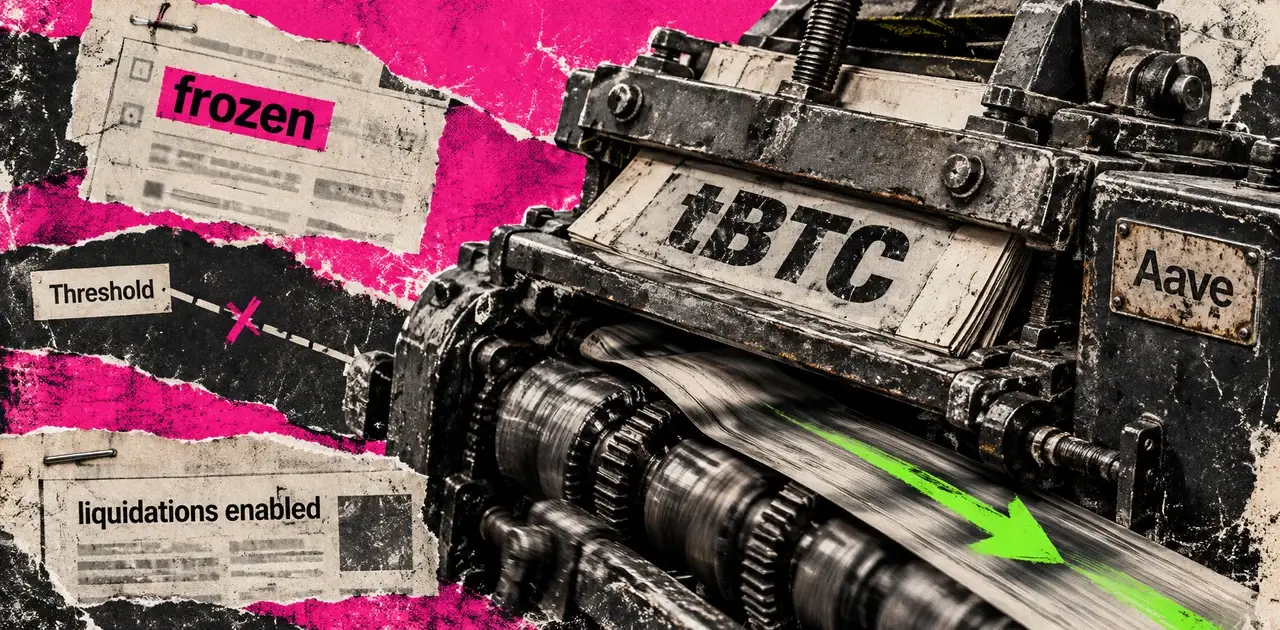
Aave has frozen its tBTC market on Ethereum after Threshold Network paused minting and redemptions on its Bitcoin bridge, and the episode shows that a collateral asset is only as safe as its exit path, not just its reserves. On October 31, Aave's guardian multisig, acting on a LlamaRisk recommendation, blocked new tBTC deposits and any use of tBTC to raise borrowing power, while leaving repayments, withdrawals and liquidations untouched.
The reassuring side of the story is the reserve data. Threshold says roughly 4,320 BTC sit in bridge wallets against about 4,185 tBTC in circulation, a surplus near 135 BTC. It also reports no unauthorized minting and no lost funds. What it has not explained is the reason for the pause, which it calls security maintenance, and it has not given a reopening date beyond promising another update within 24 hours.
A freeze is a deliberately narrow tool. Aave's Ethereum V3 Core market holds about 1,760 tBTC, worth around $136.6 million and close to 42% of the token's circulating supply. That concentration is why risk managers moved quickly: a single lending venue carries a large share of the asset. Aave's tBTC markets on Base and Arbitrum had already been frozen in earlier deprecation rounds, so the Ethereum market is where the live exposure sat.
The redemption halt matters more than the surplus figure. A wrapped Bitcoin token holds its peg because arbitrageurs can redeem it for the underlying asset whenever it trades cheaply. Pause redemptions and that anchor loosens, leaving secondary-market depth as the only way out. Gauntlet made this point directly, warning that the pause could damage tBTC liquidity and lenders' ability to exit during liquidations.
Threshold's own line is that tBTC "remains fully backed, and no funds have been lost." Backing describes the vault; liquidity describes the door.
Lending protocols liquidate by selling collateral into a market. If that market thins out while the redemption route is shut, a liquidation that looks safe on paper can realize a worse price than the oracle implies. That is the scenario a freeze is meant to keep from growing, even though it cannot erase positions that already exist.
The reaction was not limited to Aave. Gauntlet's Ethereum Morpho USDC Core vault had about 704,000 USDC supplied to a market backed by tBTC collateral. Gauntlet added that market to its emergency exclusion list and pulled roughly 65,000 USDC of available liquidity, leaving about 640,000 USDC exposed. The amounts are small, yet the pattern is useful: independent risk curators are reading the same signal and acting within hours, which is how contagion tends to travel through composable lending.
Wrapped and bridged Bitcoin tokens are widely used as lending collateral because they let holders borrow without selling. That convenience rests on a chain of assumptions: the custodians behave, the bridge keeps running, and redemption stays open. A single announcement can interrupt all three at once, which is why risk teams should pair on-chain monitoring with pre-agreed freeze playbooks.
For anyone modelling DeFi collateral risk, the lesson is to score the redemption pathway alongside proof of reserves. A bridge can be fully backed and still leave lenders with a market that cannot absorb forced selling. Until Threshold explains the pause and restarts operations, tBTC on Aave is best treated as an asset in a holding pattern rather than one that has cleared its stress test.
Keywords: Aave, tBTC, Threshold Network, collateral freeze, LlamaRisk, Gauntlet, Morpho, DeFi lending
Source: CryptoSlate